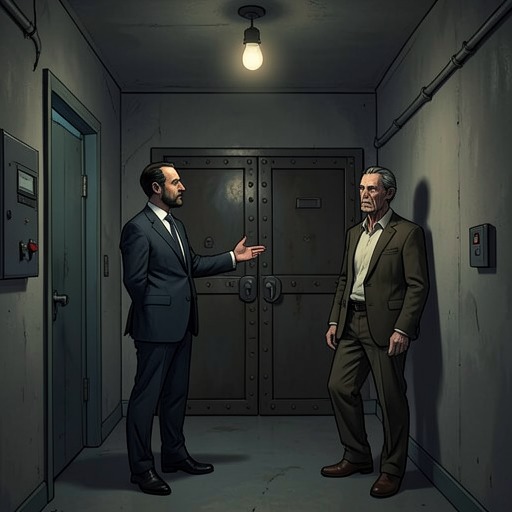
Leonard Patz’s confession and death
Defending JacobLeonard Patz’s confession and death bring the prosecution of Jacob Barber to an abrupt legal end, but do not settle what happened or erase the costs of the case. Patz dies after being subpoenaed to testify and leaves a confession investigators verify as authentic; the government then dismisses the indictment against Jacob. Later, Andrew Barber suspects that James “Father” O’Leary forced the confession, making the apparent resolution both an exoneration in court and a source of enduring uncertainty.
The confession and its timing
Jonathan Klein had Patz served with a subpoena, as he had promised the court. The next night, Patz died by suicide, leaving a full confession. Klein told Andrew that investigators had been at Patz’s apartment all night and had confirmed the handwriting; the note was genuine. The news initially seemed almost impossible to believe, but its timing made it decisive: the case against Jacob had been approaching its courtroom reckoning, and the confession identified another person as responsible.
Klein planned to move for dismissal when court opened. Before that could happen, however, Neal Logiudice filed a nol pros, formally announcing the government’s decision to drop the charges. The order therefore came not through a jury’s assessment of competing evidence but through the prosecution’s decision in response to the newly verified confession.
Jacob’s release
At nine o’clock, the judge took the bench and asked Jacob to stand. He told Jacob that he was a free man, prompting a cheer and an embrace between Jacob and Andrew. The clerk then read the formal discharge: the Commonwealth had entered a nolle prosequi, Jacob was discharged from the indictment and could go without day, and the bail previously posted could be returned to the surety. The case was dismissed.
For Andrew and Laurie, the news first arrived as a sudden reversal after a long trial. They woke Jacob and shared the confession with him, then waited in their trial clothes to go to the courthouse. They watched television and checked Boston.com for a report of Patz’s death, but found none. Their relief was intense, yet they held back from celebrating fully until the dismissal was official, knowing Logiudice might still continue the prosecution. The judge’s order transformed the news into a legal outcome: Jacob was no longer facing the indictment.
Rescue and the lost verdict
Andrew experiences the dismissal as more than an acquittal. In his account, a not-guilty verdict would mean only that the prosecution had failed to prove its case; Patz’s confession seemed to him to establish Jacob’s innocence and erase the ordeal. That distinction explains the family’s near-miraculous sense of rescue, but it also exposes how much their relief depends on accepting the confession as conclusive.
Later, Andrew confronts his father, William “Bloody Billy” Barber, about the confession. Andrew says he believes James “Father” O’Leary went to Patz’s apartment after a particularly bad day for Jacob in court, frightened him into signing a confession, and then left him dead. The account is Andrew’s reconstruction, not a demonstrated finding: Billy does not answer, and Andrew recognizes that the two men understand the same bind—without a confession, there is no case; without a case, there is no confession.
Billy calls the intervention an act that saved Jacob’s life. Andrew rejects that defense. In his view, O’Leary’s alleged intervention took away Jacob’s chance to hear a jury say he was not guilty. Even with the indictment dismissed, Andrew fears that people will continue to believe Jacob was a murderer. The event therefore closes the prosecution without producing the public, adversarial verdict Andrew considers necessary to clear his son’s name.
Legal closure, unresolved truth
The confession functions as a turning point because it changes the state’s case and Jacob’s legal status almost at once: the charges are dropped, and the court formally discharges him. But the novel distinguishes that procedural closure from certainty about the confession’s origin. The handwriting is authenticated and Patz’s confession is accepted as genuine; Andrew’s later suspicion concerns how it was obtained, not whether the note existed.
That gap leaves the outcome double-edged. Jacob is free of the indictment, yet Andrew believes the missing trial has deprived him of the strongest possible public vindication. Billy’s claim that the intervention saved Jacob and Andrew’s insistence that it denied him his day in court turn the same act into incompatible judgments: protection and loss. The case ends in law, while doubt about the means of its ending remains.